Deepak Pathak and Abhinav Gupta, Skild co-founders and robotics researchers, explain Skild’s general-purpose robot brain on the NVIDIA AI Podcast with host Noah Kravitz.
Skild’s goal is a shared brain that can control different robot types, from humanoids and quadrupeds to factory arms. The founders argue that robotics data is scarce, so experience from each task and form factor should help the brain handle future scenarios. They contrast this general approach with traditional systems built for one vertical, where unexpected physical-world conditions often prevent full automation.
The team uses robot data, video, and simulation because each has different strengths. Robot data captures sensor readings and motor commands but is costly to collect; videos are diverse and plentiful but lack details such as forces; simulation scales and measures forces but has a sim-to-real gap. Skild uses videos and simulation for pretraining, then smaller amounts of real-world data to make a model precise for its deployment task.
Deploying specialists and building a data flywheel
Tasks the brain already knows, such as walking or jumping over obstacles, may work off the shelf, while unfamiliar work can require days of robot or simulation data for fine-tuning. As specialized robots are deployed, their data can feed back into the shared brain, so later tasks may need less data. The founders describe this as a flywheel across factories, hospitals, grocery stores, hotels, and eventually homes.
Skild evaluates a deployment against task measures such as accuracy and completion time, then tests generalization to changes like obstructed workspaces or darkness. It also sets safety requirements and guardrails, such as stopping when a camera fails. The founders expect near-term deployments in factories and warehouses, while saying the timeline for home robots remains uncertain because reliability and safety are unresolved challenges.
Briefs summarise talks and interviews; timestamps open the video at that moment. Claims in a talk are the speaker's own.
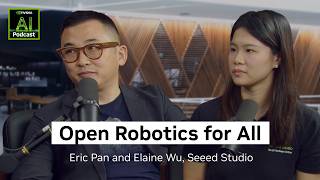
NVIDIA AI Podcast host Noah Kravitz speaks with Seeed Studio CEO Eric Pan and robotics lead Elaine Wu about open-source robot hardware, embodied AI, and building practical robots with NVIDIA technologies.
At GTC, NVIDIA Omniverse host and panelists Pras Velicodi (Agility Robotics), Ashok Elluswamy (Tesla), Chelsea (Physical Intelligence and Stanford), Arnaud Rubaire (Exon Robotics), Deepak Pathak (Scaled AI and Carnegie Mellon), and Russ discuss data, simulation, robot brains, and deploying humanoids at scale.
Deepak Pathak, a new faculty member at Carnegie Mellon University’s Robotics Institute, discusses ways to help learning systems generalize beyond training, in a Robotics Institute seminar.
NVIDIA CEO Jensen Huang discusses Europe’s AI economy, NVIDIA’s AI infrastructure and agent platforms, and physical AI at GTC Berlin, with examples from European industry and NVIDIA partners.
The host and main speaker from Robotics Central explains Kawasaki’s staged plan to deploy Kaleido humanoid robots, and how Japan’s AI funding, Nvidia computing, and human remote operators fit into that effort.