Masayuki Inaba, a robotics professor at the University of Tokyo, describes the university’s robotics research and how student-built robots developed from early tactile systems to humanoids and aerial platforms.
Inaba traces the lab’s robotics work to mechanical engineering research begun around 1960. A 1969 project used tactile sensors on a six-degree-of-freedom arm, while Inaba’s own early research used camera feedback and mirrors to guide a manipulator through a nut-making task. He argues that robots need close sensorimotor interaction with their surroundings to perform dexterous work.
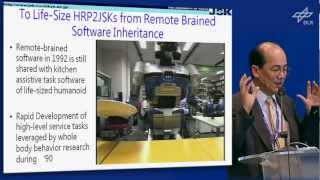
To explore different robot bodies, the lab connected mobile bases, manipulators, quadrupeds, and humanoids to offboard computers through wired commands and camera-based sensing. Students could build small robots in a few weeks and share software through the Remote Brain site. The work later expanded to life-size humanoids, including the H6 and H7, and the HRP platform, developed through a Japanese government project from 1998 to 2003.
The humanoid platform let students pursue tasks such as preparing salad, handling laundry, and riding a Segway-type G-pad. These projects required perception, tool use, task sequencing, balance, and recovery from changing forces. Inaba says a shared humanoid platform also helps a university carry research across student cohorts and adapt software for industry partners that need only selected components.
Inaba describes students integrating their work with ROS and designing musculoskeletal robots with more than 100 motors. The lab’s Kangaroo robot has a five-fingered hand that can support its own weight, porous bones, and cooling that uses latent heat. A student-built motor driver and water-cooling system helped a 60-kilogram robot jump roughly 30 centimeters, recover after falling, and compete remotely in the DARPA Robotics Challenge trials.
The lab continued developing full-body humanoids such as Jaxon, including stronger motor drivers, improved communications, liquid cooling, and hybrid passive and active legs. Inaba also describes a Kawasaki Heavy Industries platform for research and disaster response. Work combining humanoid research with multirotor designs produced a robot that could stand up, fly, and contribute to forest mapping.
Briefs summarise talks and interviews; timestamps open the video at that moment. Claims in a talk are the speaker's own.
Albert from PAL Robotics and Olivier Stasse, a robotics researcher and head of the robotics department at LAAS-CNRS, present PAL’s robots and research partnerships at VivaTech 2026 in Paris, with Maximilian operating the Kangaroo.
Luca Marchioni, robotics engineer at PAL Robotics, presents the design and early development of the Kangaroo legged robot at the ICRA 2021 Workshop on Legged Robots.
Masayuki Inaba, a researcher at the University of Tokyo’s JSK Lab, discusses remote-brain robotics and future challenges for robot bodies, software, and everyday users at the DLR Robotics Symposium with the Robotik Kolloquium.