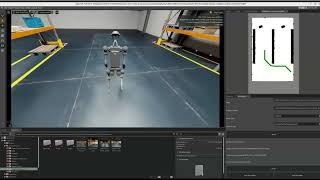
Nikolaus Correll, professor at the University of Colorado Boulder, discusses dexterous manipulation and practical paths to physical AI at Purdue ICON’s fall 2026 seminar.
Correll compares autonomous driving’s progress from the 2005 DARPA Grand Challenge to commercial rides around 2020 with the slower path of manipulation. Amazon passed one million robots in 2025, while its Vulcan system reflects a decade of development since the 2015 picking challenge. He argues that robotics has become a major industry, even though many deployments happen out of public view.
Correll sees humanoids as a possible way to bring AI into physical work, but cautions that online demonstrations can hide how much remains unsolved. He recounts experiments with bin picking, strawberry handling, shelf restocking, and kitting, including a competition-winning system. These projects showed that vision and motor-current sensing can handle some tasks without tactile sensors, while limited reach and weak industry demand constrained adoption.
For electric vehicle battery disassembly, Correll estimates that dismantling a Hyundai Ioniq 5 battery can recover about $650 more value than shredding it. His team is combining Universal Robots equipment with vision models and a natural-language interface so workers can direct robots to identify and remove battery screws. The goal is to make programming more accessible while keeping the work within familiar industrial automation systems.
Correll describes the software and control work required after buying a Unitree H1, including navigation, balance, and whole-body motion. His team uses reinforcement learning and MuJoCo model predictive control, and reports 96.7% reliability for screw picking when the robot is tethered, compared with 86.7% standing freely. He also shows how optimal control can plan grasps around a hand’s limited range of motion, and how an LLM can estimate object properties to help set grip force.
Correll’s group is building simulation assets from real scenes and demonstrations to transfer tasks to humanoids, while noting that simulated contact can differ substantially from real physics. He expects industrial progress to come through focused applications and hybrid systems rather than assuming general-purpose humanoids are ready. He also identifies safety, suitable hand design, and better hardware supply chains as central challenges.
Briefs summarise talks and interviews; timestamps open the video at that moment. Claims in a talk are the speaker's own.
Modi, a PhD researcher at Shanghai Innovation Institute, joins RoboPapers host Mike to explain EgoHumanoid, a method for combining human demonstrations with robot data to train humanoid loco-manipulation policies.
Ria, a USC assistant professor, and her student coauthors discuss their Humanoid Everyday dataset and humanoid manipulation research with the RoboPapers hosts.
Lee Yi, an assistant professor at Tsinghua University and coauthor of R2S2, discusses whole-body humanoid reaching and teleoperation with the RoboPapers hosts.
PRO ROBOTS’ main presenter covers humanoid, service, industrial, and healthcare robots at China’s 2025 World Robot Conference, with demonstrations and interviews from exhibitors.
Sergey, host at Supercar Blondie, explores Unitree Robotics’ quadruped and humanoid robots at the company’s factory in China with Unitree representative Yolanda.