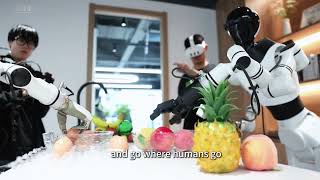
Wren says robots are meant to assist people with tasks that are dangerous or unwanted, not replace them. He expects humans to handle judgment and high-risk decisions while robots take on standardized work. He also says teleoperation and data collection can create new roles as work shifts toward managing robots.
Wren says training platforms should prepare robots for factories, warehouses, and service settings, including unexpected situations. RealMan's approach starts with teleoperation, collects data on how tasks are performed, then uses that data to train the robot model. He describes a goal of shortening tasks from several minutes to seconds as the robots learn.
Wren expects robots to handle standardized, repetitive work such as moving boxes, helping address night-shift demand and labor shortages. He says RealMan's robot school has 150 robots working across different tasks and scenarios. Customers can define scenarios, and teleoperation is used to control robots and collect training data.
Wren says jobs should be divided into tasks, with robots learning simpler standardized work while people retain high-risk decisions. He estimates robots may help with standardized tasks within one or two years. For dexterity, he describes using teleoperation devices modeled on robot arms to capture joint, camera, and whole-robot data that could help robots perform actions independently later.
Briefs summarise talks and interviews; timestamps open the video at that moment. Claims in a talk are the speaker's own.
Edward Liu of RealMan Robotics explains how RealMan is building hardware, fleet operations, and data infrastructure to move physical AI from demos to daily work at the Humanoids Summit.
Jenk Infang, head of RealMan Robotics’ humanoid robot data training center, introduces its Beijing facility and explains how it collects data to train humanoid robots for household and workplace tasks.