PRO ROBOTS· Aug 29, 2025
The Largest World Robot Conference in China
PRO ROBOTS’ main presenter covers humanoid, service, industrial, and healthcare robots at China’s 2025 World Robot Conference, with demonstrations and interviews from exhibitors.
PRO ROBOTS’ presenter reviews humanoid robots and AI systems showcased at WAIC 2026 in China, including demonstrations from AGIBOT, Fourier Intelligence, No Matrix, and others.
AGIBOT presented 60 robots across the expo, including machines for guiding visitors, making coffee, and working on a factory line. The company said its androids had completed six days on a tablet manufacturing line. Its A3 Ultra has 51 active degrees of freedom and used camera, lidar, and NVIDIA Thor computing to play table tennis without operator control.
AGIBOT’s G2 Max can lift 18 kilograms with one arm, while its X2 Edu is designed for training and experimentation. P&D Bionics showed its human-sized Atom robot climbing stairs and tackling obstacles, with teleoperation supporting hand tasks as the company develops autonomous capabilities. Fourier Intelligence demonstrated a GR-3 responding to broad requests and coordinating with other robots, alongside smaller GR-Nano companions intended for older and lonely people.
No Matrix demonstrated robots handling pharmacy orders and hotel laundry, including folding textiles. Its RoboPocket system gathered more than 100,000 hours of recordings from people in 47 Chinese cities, capturing depth and hand-object interaction to train robots on varied tasks. Keenon showed a multi-robot laundry workflow that took about four minutes and said its service robots already operate in more than 5,000 hotels.
Yunex AI showed a robot making customized pizzas and other machines preparing food, cleaning, and handling laundry. Xera AI demonstrated folding clothes and loading a washing machine, while Tencent presented Xiaolu, a massage robot trained on professional practitioners’ movements and applied force. These examples put flexible materials and safe physical interaction at the center of service robotics.
Huawei introduced Atlas 950 SuperPod, a computing system rated at up to eight exaflops, built by linking accelerators through UnifiedBus. MiniMax presented its open-source M3 model, with 427 billion parameters and a context window of up to one million tokens. The demonstrations connected robot capabilities to larger systems for training, planning, and coordinating machines.
Briefs summarise talks and interviews; timestamps open the video at that moment. Claims in a talk are the speaker's own.
PRO ROBOTS’ main presenter covers humanoid, service, industrial, and healthcare robots at China’s 2025 World Robot Conference, with demonstrations and interviews from exhibitors.
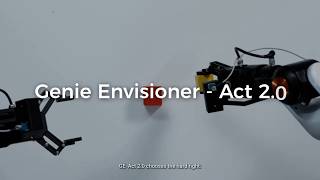
An AGIBOT presenter explains how GE-Act 2.0 is pretrained and scaled for robot manipulation, and how it performs across unfamiliar objects and settings.
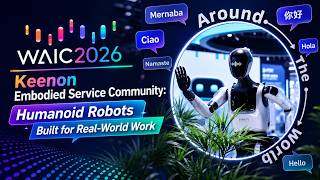
X-Man, Keenon Robotics’ virtual guide, presents the company’s humanoid robots at WAIC 2026, including demonstrations created with Nowa Coffee and modeled on Park Inn by Radisson hotel operations.
A Crystal field report from the World AI Conference in Shanghai covers Keenon Robotics’ humanoid laundry robot and the company’s overseas markets.
Thomas, founder and host at AsiaBits, explains how Chinese phone makers and robotics firms are scaling humanoids, expanding into Europe, and influencing manufacturing plans in Japan.
Diana Wolf Torres, robotics newsletter writer at Droids and chief evangelist at Lightwheel, discusses physical AI and robotics at NVIDIA GTC 2026 with host Jonathan Stevens on the Thinking Machine podcast.