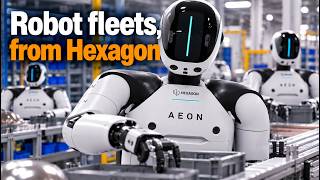
AEON uses cameras and sensors across its head and upper body to perceive surroundings, navigate, and identify objects it can handle. For walking, Hexagon trains robot agents in virtual environments with reinforcement learning. Thousands of simulated robots can train for 10 to 14 hours on one GPU, practicing tasks such as stepping over obstacles and moving across ramps or gravel.
Hexagon focuses on matching the simulation to the physical robot, including actuator behavior and CAD-based values for weight and inertia, with NVIDIA and maxon. A prototype demonstrated walking, stairs, and a hybrid rolling and walking policy. The team is also building a Zurich office digital twin from reality capture data and adding cameras to simulation training.
For manipulation, an operator’s hand and finger movements are tracked with an Apple Vision Pro and mapped onto AEON. Hexagon collects about 30 to 40 demonstrations per part, then trains an Action Chunking Transformer policy for the robot to replay. One example has AEON placing six reflective motor parts, and the team is developing automated setups to train more robots.
The presenter says simulation cut AEON’s initial training and tuning cycle to two or three weeks after components arrived in mid-March. Digital twins can also help prepare demonstrations before a robot reaches a physical venue; Hexagon modeled a keynote stage in advance and explored possible scenarios. The same virtual environments are used in software integration and deployment workflows.
Hexagon expects imitation learning to make robot training more accessible because an operator can demonstrate a task instead of programming it. The current process takes about 30 to 40 iterations per part, and the team expects synthetic simulation data to reduce that number and improve robustness. The presenter describes combining demonstrations with foundation models as a path toward broader robot deployment.
Briefs summarise talks and interviews; timestamps open the video at that moment. Claims in a talk are the speaker's own.
Arno Rober, president of Hexagon Robotics, talks with John Koetsier on NEXT about preparing Aeon robot fleets for factory work, including the Schaeffler plan to train, deploy, and scale toward 1,000 robots.
Hexagon Robotics President Arno Rober talks with NEXT host John Koetsier about preparing AEON humanoid robots for factory work, including a planned path to 1,000 robots with Schaeffler.
PRO ROBOTS’ main presenter covers humanoid, service, industrial, and healthcare robots at China’s 2025 World Robot Conference, with demonstrations and interviews from exhibitors.