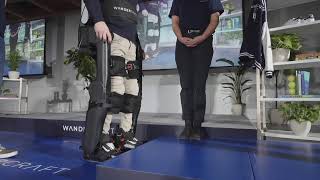
Matthieu Masselin, CEO of Wandercraft, explains how the company designs its Atalante exoskeleton to help people with different bodies and impairments walk, in a Legged Robots workshop hosted by Aaron.
Masselin says an exoskeleton could help many people regain mobility only if it adapts to differences in height, weight, waist size, spasticity, and pathology. Wandercraft built a mobile app and server workflow to use patient details to generate personalized motion plans, aiming to return them in under five minutes for a busy rehabilitation clinic.
Wandercraft combines full dynamical models of the patient and exoskeleton, physical limits, and gait requirements in an optimal control problem. Direct collocation and sparse numerical optimization reduced trajectory generation from about three days to under a minute, with the team checking that plans converge across its patient database. The company also trains a neural network on generated trajectories to produce new motions in milliseconds.
Atalante offers gentle short steps for first use, a faster foot-rolling gait, and turning motions to help users move around a rehabilitation center. Therapists can adjust how much effort the exoskeleton supplies: Masselin describes settings from roughly 90 to 95 percent assistance for someone needing substantial support down toward almost no assistance as a patient recovers. The system senses movement through actuator data, foot sensors, and inertial measurements.
Cybathlon challenges helped the team develop motions for stairs, doorways, and rising from a low sofa, sometimes using upper-body momentum to help the user stand. Wandercraft also tests stability with a crash-test dummy and reported resisting pushes from multiple directions, while noting that directional correction still needed a person’s help. Masselin sees steps, thresholds, and getting into a cab as practical priorities before jumping.
Masselin says the company aims to bring the device's cost down to the low tens of thousands of euros, drawing a comparison with motorcycle complexity and arguing that broad adoption could reduce costs. He reports trials with people of varied ages, conditions, and fitness levels, including severely impaired patients, and says regulatory clearance shapes who can use the device. Future work may tailor interfaces to different pathologies and increase dynamic capability while keeping patients comfortable.
Briefs summarise talks and interviews; timestamps open the video at that moment. Claims in a talk are the speaker's own.
Wandercraft chairman Nicolas and company colleagues, including co-founder Jean and engineer Matthieu Masselin, present the company’s personal exoskeleton in a keynote with rehabilitation researcher Dr. Anne Spungen and user Kevin.