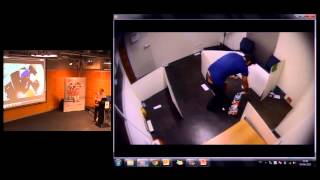
An Aldebaran Robotics presenter at LinuxTag 2012 in Berlin explains how the company built NAO, chose Linux and Gentoo for its software platform, and worked with developers to expand its applications.
NAO is a programmable humanoid robot with 25 degrees of freedom, cameras, microphones, sonar, touch sensors, and balance sensors. Its head contains an Atom-based x86 computer that communicates with electronics in the chest. Aldebaran began developing it in 2005 and sells versions with different hardware configurations.
Aldebaran’s developer program supports people creating applications for NAO. Choregraphe lets users connect visual programming blocks, with Python available inside those blocks; developers can also use Python or C++, with some .NET, Java, and MATLAB support. The company described an application store modeled on Android and iOS.
The robot’s software moved from a kernel-only setup to Buildroot, then OpenEmbedded, and later Gentoo. The presenter said Buildroot was difficult to maintain as a full system, while OpenEmbedded required recipes and repeated builds for packages such as GCC and Boost. Gentoo offered package access and newer upstream versions; the team had also considered Debian but wanted updates sooner.
Aldebaran used Linux distributions and open-source packages, and relied on Qt Creator as its main IDE. The company began sharing projects on GitHub after internal concerns about giving code to competitors, but access to the developer program still involved selection. The presenter hoped to make the SDK easier to download and said the robot’s hardware remained closed.
Aldebaran positioned its developer program as a way for researchers to build applications and report problems or desired features. The presenter cited a $12,000 academic price and a $3,000 developer-program price. In the discussion, he named a “follow me” feature as a possible popular application and described the larger Romeo project, aimed at a 1.5-meter robot.
Briefs summarise talks and interviews; timestamps open the video at that moment. Claims in a talk are the speaker's own.
Masayoshi Son, CEO of SoftBank, presents Pepper with Aldebaran founder Bruno Maisonnier and Foxconn chairman Terry Gou, outlining their plans for an emotion-aware personal robot at a Tokyo press event.
R. Gelin of Aldebaran Robotics presents collaborative research projects with French, Asian, and European partners, showing work on NAO and Romeo in healthcare and personal assistance.
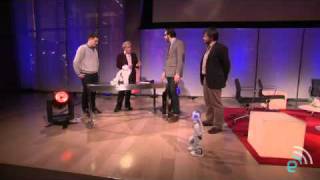
Jérôme and Aldebaran Robotics representatives discuss NAO’s research and education uses, developer program, pricing, and plans for future consumer and care applications with the Engadget Show hosts.