Dr. Gill Pratt, Chief Scientist at Toyota Motor Corporation and CEO of Toyota Research Institute, discusses technology strategy and carbon reduction at a leadership talk hosted by Autos2050.
Pratt describes simultaneous shifts in connectivity, autonomy, shared mobility, and electrification as opportunities that also bring uncertainty. Drawing on his work at DARPA, he argues that technology forecasts often fail and that progress depends on exploring multiple approaches, accepting risk, and learning from failures.
When Toyota Research Institute began working on automated driving, Pratt says the company pursued two tracks: Guardian, an active safety system, and Chauffeur, a self-driving concept. This strategy aimed to improve safety sooner while continuing research on the harder goal of full autonomy. He says TRI demonstrated Guardian capabilities beyond existing ADAS systems within a few years.
Pratt argues for a mix of hybrids, plug-in hybrids, battery electric vehicles, and fuel cell vehicles to cut emissions sooner and serve different drivers. He points to variation in charging access, electricity sources, income, and driving needs. Toyota committed to introduce 70 electrified models globally by 2025, including 15 battery electric models.
Pratt frames battery manufacturing emissions as a carbon investment and calls the emissions avoided over a battery’s use its carbon return on investment. Using U.S. driving data and average grid emissions, Toyota researchers found hybrid and plug-in hybrid lifetime emissions comparable to battery electric vehicles at lower cost. He illustrates the allocation argument by comparing one 320-mile-range battery electric vehicle with eight 40-mile plug-in hybrids serving 32-mile commutes; longer trips and better charging access can make a battery electric vehicle the better fit.
Pratt describes Toyota’s battery development and supply chain investment, including $3.4 billion for U.S. facilities and research aimed at lowering battery costs by at least 30%. Toyota Research Institute is developing AI tools to find materials for batteries and fuel cells, while a $150 million Toyota Ventures fund backs early-stage work in areas such as renewable energy, hydrogen, and carbon capture. Toyota’s 2030 outlook is 8 million electrified vehicles sold annually, including 2 million zero-emission vehicles.
Briefs summarise talks and interviews; timestamps open the video at that moment. Claims in a talk are the speaker's own.
Akio Toyoda, president of Toyota Motor Corporation, and Gill Pratt, incoming CEO of the Toyota Research Institute, discuss Toyota’s plans for AI, safer and more accessible mobility, and robotics at a press conference with each other.
Akio Toyoda, president of Toyota Motor Corporation, and Gill Pratt, CEO of the new Toyota Research Institute, outline plans for AI research at a Toyota press conference in Japan.
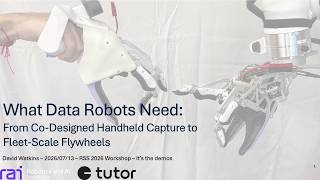
David Watkins, a robotics researcher whose talk covers work at RAI and Toyota, discusses demonstration capture, robot hardware and data collection at Toyota’s 100-robot facility.
James Kuffner of Toyota Research Institute reflects on 30 years in robotics and the challenges of building safe, intelligent machines, speaking at an IEEE Robotics and Automation Society event.