European Space Agency, ESA· Aug 8, 2025
How astronauts control robots from space
An ESA and DLR team member explains how astronaut Johnny Kim controlled robotic teams from the International Space Station during the Surface Avatar experiment.
Gerd Hirzinger, director of DLR’s Robotics and Mechatronics Center (RMC), reviews the center’s work across space robotics, compliant robot arms, medical applications, mobile systems and 3D modeling at the DLR Robotics Symposium in Oberpfaffenhofen.
Hirzinger credits the RMC’s growth from four or five people to about 300 to skilled engineers, long-term support from DLR directors and funding from Bavarian and federal ministries. He describes his own role as encouraging work across fields and building synergies.
The 1993 ROTEX experiment on Space Shuttle Columbia let operators on Earth and astronauts control a robot despite roughly six seconds of communication delay. Hirzinger also highlights the SpaceMouse spin-off and the 1999 ETS-VII mission, which demonstrated remote programming and satellite attitude control by moving a robot arm. He argues that servicing satellites could extend their useful lives, with DEOS among the planned missions.
DLR’s lightweight robot generations use torque control and impedance control to move safely in contact with people and objects. Hirzinger points to demonstrations of hand-guided programming and assembly that combines vision with force feedback, including a possible Daimler gearbox assembly application. He also describes DEXHAND and the Justin-based system, while framing home service robots as aids for simple tasks rather than substitutes for human care.
Hirzinger connects robot control to prosthetic fingers and surgical telepresence, including a small integrated system intended to track a beating heart for surgery. Other projects include asteroid and planetary rovers, the ExoMars rover, a lunar rover concept and a car with independently controlled wheel hub motors. DLR also applies its stereo vision and lightweight motors to UAVs that map terrain and buildings in 3D.
The center builds terrain models from orbital and aerial images, including Mars imagery and Earth landscapes resolved to tens of centimeters. Hirzinger describes using detailed models for pilot training and city mapping, and combining cameras with laser scanners to reconstruct objects in real time. He summarizes the RMC’s approach as transferring mechatronics methods among space, terrestrial robotics, surgery, aircraft, mobility and 3D modeling.
Briefs summarise talks and interviews; timestamps open the video at that moment. Claims in a talk are the speaker's own.
An ESA and DLR team member explains how astronaut Johnny Kim controlled robotic teams from the International Space Station during the Surface Avatar experiment.
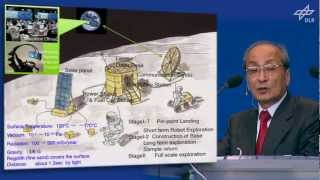
Hirochika Inoue, robotics researcher and professor emeritus at the University of Tokyo, discusses humanoid robotics, lunar exploration, and robots as human agents at the DLR Robotics Symposium in Germany with DLR researchers including Gerd Hirzinger.