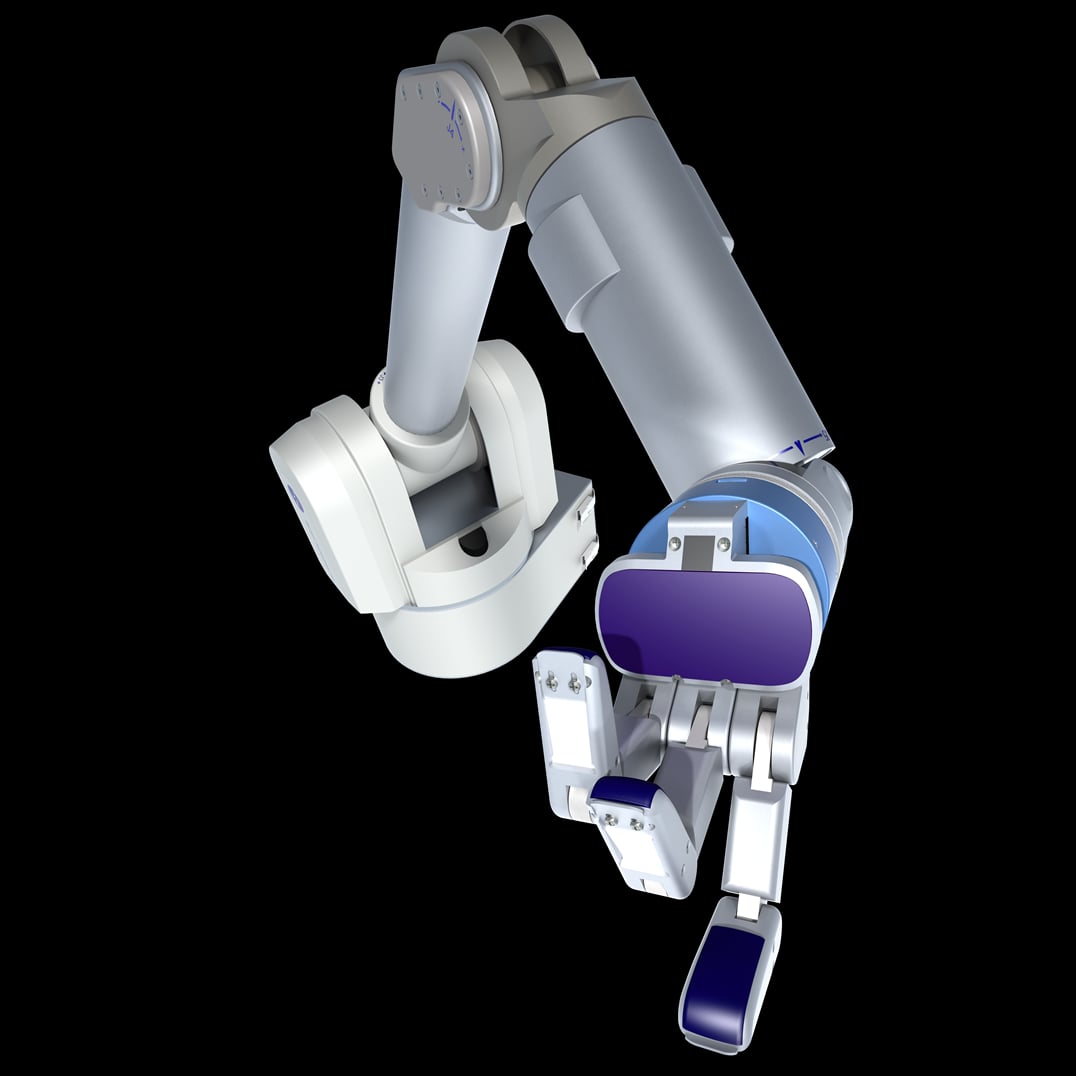
WAM®
CommercialActive since 2004
A highly dexterous, naturally backdrivable manipulator arm for industrial robotics, research, planning and manipulation, and haptics and teleoperation. It is available in 4-DOF and 7-DOF configurations.
About
Barrett Technology introduced the WAM (Wristed Arm Manipulator) in the mid-2000s as a lightweight, torque-controlled robotic arm intended for research and advanced manipulation work. It was designed around backdrivability and low-friction actuation, which made it suitable for force interaction, haptics, and teleoperation in addition to standard manipulation tasks.
The WAM became known in academic and industrial robotics for its 7-DOF configuration and natural, human-arm-like kinematics, and Barrett later offered a 4-DOF version as well. Over time it has remained in use in laboratories and development environments, especially where precise control, contact-rich behavior, and safe physical interaction matter. The model has not been publicly discontinued in the historical record I know.
Specifications
Motion
- Motor tech
- Brushless rare-earth motors
- Gear tech
- Direct-drive capability with cable drives; zero-backlash and near-zero friction
Sensing & Compute
- Connectivity
- Ethernet cable
- Tactile / force sensors
- Force/Torque sensor mentioned in configuration options; control of contact forces is robust independent of mechanical force or torque sensors
Safety & Market
- Primary market
- Industrial robotics / research / planning and manipulation / haptics and teleoperation
- Availability
- Commercial
Timeline4
- 2010-01-01 · milestone~4-DOF option is offered
Barrett also provides a four-degree-of-freedom configuration for applications needing a simpler arm.
- 2006-01-01 · milestone~7-DOF configuration becomes known
The WAM is widely associated with a seven-joint configuration for dexterous manipulation.
- 2005-01-01 · milestone~WAM gains research adoption
The arm appears in academic and laboratory use for control, teleoperation, and force interaction studies.
- 2004-01-01 · release~Barrett releases WAM arm
Barrett Technology introduces the Wristed Arm Manipulator for robotics research and manipulation.